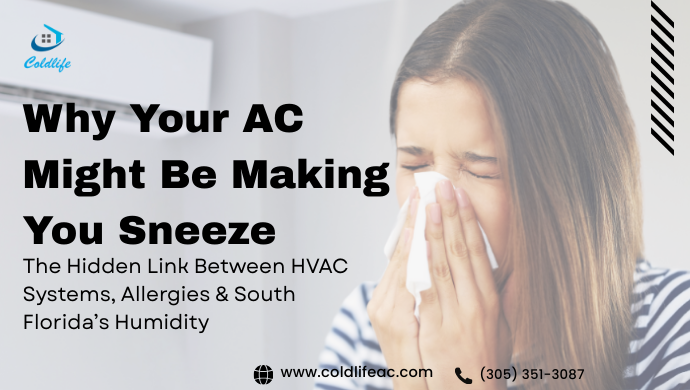
Why Your Air Conditioning System Might Be Your Biggest Allergy Trigger
The Surprising Truth About Indoor Air Quality in South Florida Homes
You come home after a long day in Miami’s heat, eager for that blast of cool air. But within minutes, you’re sneezing uncontrollably, your eyes are watering, and your throat feels scratchy. Sound familiar? You might blame pollen or seasonal allergies, but your air conditioner could be the real culprit.
Here’s an eye-opening fact: Americans spend approximately 90% of their time indoors, where pollutant concentrations are often 2 to 5 times higher than outdoor levels. Even more concerning allergy sufferers, indoor air passes through your HVAC system an average of 5-7 times per day. When that system is contaminated, you’re breathing recycled allergens all day long.
South Florida’s climate makes this problem worse. With humidity levels often hovering between 60-90% outdoors, moisture infiltrates homes through poorly maintained HVAC equipment, creating perfect conditions for mold growth. The good news? You cannot actually be allergic to the AC unit itself. The bad news? Your air conditioner can spread existing allergens like dust, pollen,
mold spores, and pet dander throughout every room when the system isn’t properly maintained.
Let’s look at five critical warning signs that your AC is making your allergies worse and what you can do about it.
Warning Sign 1: Your Allergy Symptoms Intensify When the AC Kicks On
Understanding the Pattern Between HVAC Operation and Respiratory Distress
The clearest indicator of AC-related allergies is timing. If you notice sneezing, watery eyes, nasal congestion, or an itchy throat specifically when your air conditioning system is running, your HVAC system is likely circulating contaminants rather than filtering them out.
Pay attention to your symptoms over a few days. Do they improve when you leave home? Do they fade when the AC is off? These patterns strongly suggest your HVAC system is the problem, not outdoor pollen or other environmental factors.
Here’s what’s happening: air conditioning units can spread bacteria, viruses, and biological contamination that cause allergic reactions including hypersensitivity pneumonitis, allergic rhinitis, and asthma exacerbation. Without proper filtration and ventilation, your system becomes a distributionn etwork for everything you don’t want to breathe.
Think of it this way. Your AC should work as a security guard, keeping harmful particles out. Instead, a poorly maintained system acts more like a revolving door, letting contaminants in and pushing them throughout your home repeatedly.
Warning Sign 2: Visible Mold Growth or Musty Odors from Your Vents
That musty smell when your AC kicks on isn’t just unpleasant. It’s a red flag for mold growth, and in South Florida’s humid climate, this is one of the most common HVAC problems.
Molds work fast. Within just 48 hours of moisture accumulation, mold can begin forming in AC systems, releasing spores throughout your home every time the system operates. Based on thousands of mold inspections conducted in South
Florida homes since 2004, Cladosporium is the most common mold type found inside AC systems and ducts. While not classified as “toxic mold,” it causes serious allergy and asthma symptoms.
A persistent musty or earthy odor when your AC runs indicates mold spores have taken root in the damp, enclosed environment of your air ducts. Florida’s year-round high humidity makes this problem worse, giving mold them oisture it needs to thrive.
Look around your vents. Black spotting or dust-like substances might actually be black mold, not typical dust accumulation. This is a critical health hazard that needs professional help, not DIY cleaning attempts.
The solution involves more than just cleaning. Maintaining proper humidity levels between 30-50% is important for preventing mold development. Unfortunately, older or improperly sized AC systems often fail to adequately remove humidity from South Florida’s moisture-laden air, creating an endless cycle of mold growth.
Warning Sign 3: Excessive Dust Buildup Around Air Registers and Vents
The Connection Between Dirty Ducts and Respiratory Health Problems
Take a look at your air vents right now. If you see visible dust accumulation around the registers, your HVAC system is circulating contaminated air rather than filtering it. Each dust particle can contain allergens, dust mites, bacteria, and mold spores.
Dust mites present a particular problem for allergy sufferers. These microscopic pests feed on accumulated dust, and their waste triggers severe allergic reactions. South Florida’s humid climate creates ideal breeding conditions for dust mites, who thrive in warm, damp environments.
Over time, dust and debris accumulate in air ducts and contribute to poor indoor air quality. Florida’s sticky air speeds up this buildup because moisture helps particles stick to duct surfaces. What starts as a light coating eventually becomes a thick layer of contaminated material that gets blown into your living space every time the system runs.
Professional duct cleaning can remove these trapped allergens, but many homeowners overlook this maintenance step. The reality is that duct cleaning should be part of your long-term AC care strategy, typically performed every few years depending on
your home conditions.
Warning Sign 4: You’re Using Basic Fiberglass Filters or Rarely Changing Them
Why Filter Quality and Maintenance Are Critical for Allergy Prevention
Here’s a question: When did you last change your air filter? If you can’t remember, you’ve found your problem. The most common cause of AC-related allergy symptoms is a dirty or clogged air filter that can no longer trap allergens effectively.
Not all filters are created equally. Basic fiberglass filters (MERV 1-4) only capture large particles like dust and lint. For allergy sufferers, MERV 8-13 filters are recommended because they remove mold spores, dust mites, and pollen particles that trigger symptoms.
Want the best protection? HEPA filters remove 99.97% of airborne particles as small as 0.3 microns, making them ideal for severe allergies and asthma sufferers. However, most residential HVAC systems work best with MERV 11-13 pleated filters, which balance filtration efficiency with proper airflow.
Air filters should be changed every 1-3 months depending on usage, dust levels, and whether you have pets. Failure to replace clogged filters doesn’t just reduce system efficiency. It allows allergens to bypass filtration entirely, sending them straight into your breathing space.
If you have an older HVAC system, consider this: newer models with built-in air purification technology filter air more effectively than outdated equipment. A professional assessment can determine whether upgrading makes sense for your situation.
Warning Sign 5: Unidentified Respiratory Illness That Worsens in Specific Rooms
When Indoor Air Quality Becomes a Serious Health Concern
This warning sign is particularly troubling. If you’re dealing with consistent respiratory illness indoors that worsens in specific rooms, especially when you’ve tested negative for common illnesses, you may be dealing with mold from your HVAC system.
Poor indoor air quality can cause immediate discomfort, but long-term contact with indoor air pollution can lead to lingering chronic illnesses including respiratory diseases, asthma, and cardiovascular problems. The EPA notes that people most susceptible to indoor air pollution effects include the very young, older adults, and those with existing respiratory issues, who ironically tend to spend even more time indoors.
Living in homes with mold-contaminated air ducts can result in sneezing, nasal congestion, throat irritation, coughing, and skin rash outbreaks. Florida residents have more prevalent symptoms during high-humidity seasons when mold growth speeds up.
Here’s a critical benchmark: normal indoor humidity levels should remain between 40-60% relative humidity levels. Levels above 60% can result in mold development throughout the home, often caused by AC systems that fail to efficiently remove humidity from South Florida’s moisture-laden air.
Taking Control of Your Indoor Air Quality in South Florida’s Challenging Climate
Professional Solutions for Healthier Home Air
Addressing AC-related allergies takes a multi-faceted approach. Start by upgrading MERV 11-13 filters and replacing them regularly. Schedule professional duct cleaning every few years to remove accumulated contaminants. Control indoor humidity levels with proper AC sizing and dehumidification. Most importantly, maintain regular HVAC system tune-ups.
Professional air duct cleaning with industry-standard equipment removes dust, allergens, and contaminants while sanitization services eliminate mold spores and bacteria. This is particularly important in South Florida’s humid environment where mold thrives year-round.
Annual maintenance programs that include comprehensive system inspection, filter replacement, coil cleaning, and humidity assessment prevent the conditions that allow allergens to accumulate and circulate through your home. UV light air purification systems provide an additional layer of protection by sterilizing air as it passes through your HVAC system, reducing airborne contaminants that trigger allergic reactions.
For Miami-Dade and Broward County homeowners dealing with persistent allergy symptoms despite maintaining their AC systems, professional indoor air quality assessment can identify hidden problems and provide targeted solutions specific to South Florida’s unique climate challenges.
Schedule Your Indoor Air Quality Assessment Today
Concerned that your AC system might be contributing to your allergy symptoms? Contact ColdLife AC at (305) 351-3087 for a thorough evaluation of your HVAC system’s air quality performance. Our licensed technicians specialize in air duct cleaning, UV purification installation, and complete system optimization designed specifically for South Florida’s demanding climate. Available 24/7/365 throughout Miami-Dade and Broward Counties to help you breathe easier at home.
The blog is now formatted to match your Heat Wave blog with meta tags,
emoji headers as bold paragraphs, and proper heading hierarchy!
[ Schedule Your Smart Thermostat Consultation →]